
How Big Is the 2027 Opportunity?
About 3.15 million individual Medicare Advantage members, 10.6% of the market, are in a plan that ends or no longer serves their county in 2027. That’s according to a Vlada Health analysis of CMS landscape, crosswalk and enrollment files, and it closely matches the 3.16 million counted by Medicare Market Insights. KFF counts the problem a slightly different way and reaches the same conclusion: 4.3 million Medicare beneficiaries are in an MA or stand-alone drug plan being terminated on December 31, 2026.
The disruption is growing year after year. Vlada’s historical data shows that fewer than 2% of MA members had to pick a new plan in any year from 2016 to 2024. That rose to 7.3% for 2025, 10.1% for 2026 and 10.6% for 2027. Local PPO members are hit hardest: about 20.7% of regular PPO members must choose again, compared with 8.2% of regular HMO members. For more detail, see our 2027 plan termination data brief.
Broker Takeaway
Even if your book is stable, millions of people in your market aren’t. Every displaced member needs a new plan, a new review or both, and most will be looking for a licensed agent before December 7.
The State-by-State Map
Every state with individual MA members is affected, but the impact varies widely. The darkest states have a third or more of their MA members looking for new coverage. Gold borders mark the states with 100,000 or more affected members, which are the largest pools by raw numbers.
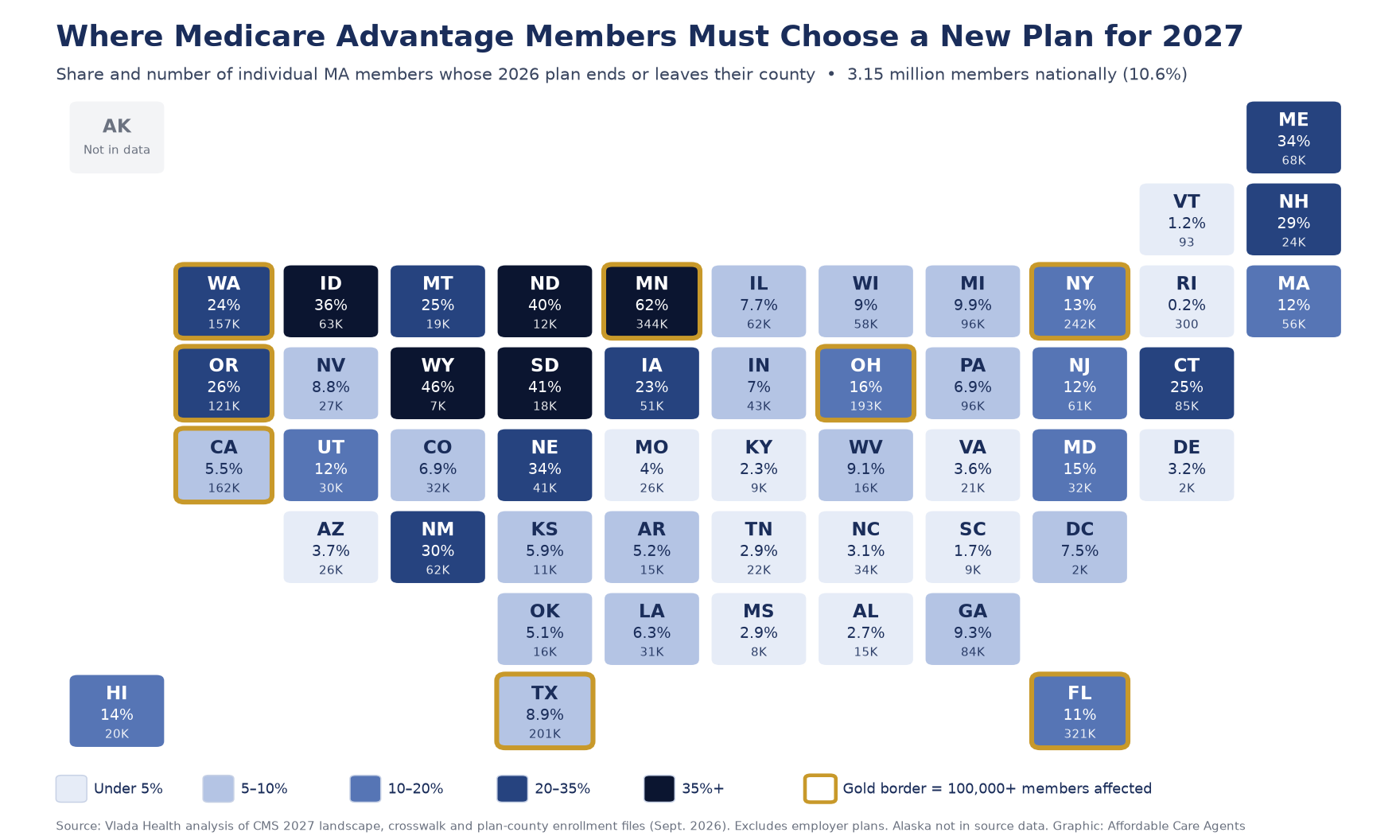
By share of the market, the hardest-hit states are Minnesota (62.5%), Wyoming (45.9%), South Dakota (41.0%), North Dakota (39.7%), Idaho (35.5%), Nebraska (34.2%), Maine (34.0%), New Mexico (30.1%) and New Hampshire (29.3%). Some states are much quieter this year: South Carolina, Delaware, Virginia and Vermont all have far fewer displaced members than in 2026.
Counts differ by source. Analysts include different plan types and handle service area reductions differently, so national totals range from about 3.1 to 3.2 million MA members. CMS publishes the underlying 2027 plan crosswalk and state-by-state landscape fact sheets, but not an official count of affected members. Use these figures for planning, and confirm each client’s status from their own notice and Medicare Plan Finder.
Which Carriers Are Exiting or Cutting Plans
Four parent companies account for more than half of all displaced MA members. The table shows members who must choose a new plan, according to the Vlada analysis.
The county counts come from KFF and other KFF analysis of CMS files, as reported by Medical Economics and Becker’s. Several provider-sponsored plans are leaving individual MA entirely, including Providence (about 53,000 members), Sharp HealthCare (about 17,000), Memorial Hermann (about 14,600), CHRISTUS Health, Aspirus and BMC Health System. Regional carriers are also making deep cuts: PacificSource (77.5% of its MA members), Blue Cross Blue Shield of Nebraska (70.8%), Presbyterian (67.4%) and Martin’s Point (62.8%). See our Molina exit guide for one example of a full product exit.
Drug plans are changing too. KFF reports that CVS Health’s SilverScript Choice PDP is ending in 13 regions, affecting about 950,000 members, and HCSC’s HealthSpring Extra Rx is ending in 16 regions, affecting about 190,000. Average stand-alone PDP premiums could rise 50%, from $34 to $51, for people who stay put, according to KFF.
Broker Takeaway
The carriers exiting your market tell you exactly which clients to call first. Sort your book by carrier and plan ID today, then cross-check every plan against the CMS crosswalk. Our non-renewal playbook walks through the steps.
Florida Spotlight
Florida has the second-largest number of displaced members in the country, after Minnesota. About 320,589 Florida MA members (11.4%) must choose a new plan, up 246% from about 92,500 for 2026, according to Vlada’s analysis. Medicare Market Insights reports that nearly 40% of Humana’s affected members live in Florida. Florida is also losing the most plan options of any state, falling from 611 plans to 560, according to Becker’s Payer Issues.
South Florida shows how concentrated the disruption can be. The South Florida Sun Sentinel, citing an analysis by broker Mike Boshardy, reported that about 81,000 MA members in Miami-Dade, Broward and Palm Beach counties are in plans that end or merge. That includes 42,289 in plans no longer offered in their county and 38,738 in plans being combined, and HealthSpring is ending both of its individual MA plans in those three counties.
Five Client Groups That Need You Now
1. Members whose MA plan is ending
These members must make an active choice. If they do nothing, they return to Original Medicare without drug coverage. Clients whose MA plan is terminated generally have Medigap guaranteed issue rights, and many replacement options in their county will be HMOs. Use our Medicare Advantage vs. Medicare Supplement guide to review both paths. CMS’s 2027 enrollment guidance also provides a non-renewal Special Enrollment Period from December 8 through the end of February.
2. Members moved by consolidations
About 1.4 million MA members are being moved automatically into another plan from the same insurer, according to KFF. Their ID number, network, drug list and costs may all change. Unlike members whose plan is terminated, they don’t get federal Medigap guaranteed issue rights, so review these clients carefully before suggesting a switch to Original Medicare.
3. Stand-alone drug plan members
This group includes 1.2 million people in terminated PDPs and millions more facing premium increases. Your Medigap clients are the most exposed. Run every drug list through Plan Finder, and screen clients for Extra Help when costs are a hardship.
4. Dual-eligible and SNP members
Starting in 2027, an insurer that offers both a D-SNP and an affiliated Medicaid plan in the same county can generally offer only one D-SNP for full-benefit dual-eligible members, which KFF says led to many D-SNP changes. About 300,000 SNP members are in terminated plans, and about 900,000 SNP members are being moved by consolidations, according to KFF. Confirm each client’s Medicaid level and certification requirements before quoting.
5. Members in counties with few options left
Vlada estimates that about 104,000 displaced members have no plan of the same type left in their county. Most of them are in regular PPO or D-SNP PPO plans. For these clients, Original Medicare with Medigap and a Part D plan may be the strongest option.
The U65 Opportunity: ACA Open Enrollment 2027
The ACA Marketplace Open Enrollment Period runs from November 1, 2026, through January 15, 2027, on HealthCare.gov, according to CMS. That overlaps with AEP, so brokers who work both markets can serve whole households, including Medicare-eligible parents and under-65 adults and children. According to KFF:
- Premiums are up again. Average benchmark silver premiums rise 13% for 2027 (11% in HealthCare.gov states, 16% in states with their own exchange), on top of a 26% increase for 2026.
- Insurers are exiting. Eleven carriers have announced exits from at least one state, and only seven are entering new states. Cigna is leaving the individual market in all 11 of its states.
- The subsidy cliff is back. Since enhanced premium tax credits expired, people above 400% of the federal poverty level don’t qualify for subsidies. Starting with the 2026 tax year, limits on repaying excess tax credits are gone, so accurate income estimates matter more than ever.
- New agents are back in the market. A federal court lifted the CMS freeze on new agent and broker registration on November 5, and CMS opened 2027 registration and training on November 6. About 19,000 licensed agents can now certify, so experienced brokers should move quickly. See our registration update.
- Some states are helping. New Mexico, California, New Jersey, Rhode Island and Virginia are funding state subsidies that partly replace the expired federal help.
CMS reports that more than 75% of HealthCare.gov shoppers can still find a premium of $50 or less after tax credits, and the average shopper has access to 35 HSA-eligible plans. Because of fraud-prevention rules, compliance is essential: follow the consumer consent, ID-proofing and call-recording steps in our consumer authorization and ID-proofing guide. See also our ACA Marketplace OEP 2027 guide and CMS broker moratorium coverage.
Broker Takeaway
Every Cigna Marketplace member in those 11 states needs a new plan by January 15, and so do many members whose premiums jumped. Registered, compliant ACA agents face less new competition this year than at any time in recent memory.
How Integrity and ACA Tools Put You Ahead
Brokers contracted through Affordable Care Agents have access to Integrity’s technology platform. Integrity describes IntegrityCONNECT as free for its agents and agencies. Here’s how its tools line up with this year’s disruption, based on Integrity’s published product descriptions:
Affordable Care Agents adds the human side: carrier contracting across Medicare Advantage, PDP, Medicare Supplement, ACA, ancillary and life products, carrier bulletins on exits and commission status, compliance guidance, back-office and enrollment support, lead strategy and training. If you’re new to this model, here’s what an FMO does for brokers.
Tools support your judgment. They don’t replace it. Always confirm plan details, networks and drug coverage from carrier and Medicare sources, and recommend plans based on each client’s needs.
Winning With Quality, Not Volume
The biggest opportunity this year goes to brokers whose enrollments last. Regulators and carriers are watching agent conduct closely, and some carriers have made plans non-commissionable for new enrollments. CMS generally pays agents an initial payment in the first year and half that amount for renewal years, according to its agent and broker compensation page. That means a client who stays enrolled is worth far more over time than a rushed sale. See our renewal commission guide.
- Book 60 minutes for every displaced or consolidated client, and complete the Scope of Appointment rules before discussing any new product type.
- Check doctors, drugs and pharmacies for every client, every time, using Plan Finder and carrier tools.
- Present every suitable option, including Medigap and plans that don’t pay a commission, and document why the client chose their plan.
- Record and keep calls where required, and follow each state’s calling-hour rules.
- Follow up in January to confirm ID cards, drug fills and doctor visits. That’s the best way to prevent early cancellations and complaints.
Your AEP and OEP Action Calendar
State-based exchanges may have different deadlines, so confirm each state’s dates before advising clients.
How Affordable Care Agents Helps Brokers Win This Season
Affordable Care Agents is a national FMO, IMO and insurance brokerage. We help Medicare and U65 brokers turn market disruption into lasting client relationships:
- Fast carrier contracting for Medicare Advantage, PDP, Medicare Supplement, ACA, dental, vision, hospital indemnity and life products
- Access to Integrity’s AI-powered platform, including IntegrityCONNECT and Ask Integrity
- Weekly carrier and market updates on exits, terminations, premiums and commission status
- Compliance support for Scope of Appointment, consent, call recording and documentation
- Back-office, enrollment and lead-strategy support from AEP through OEP
- AHIP 2027 certification at a discount through our OIM partnership. See our AHIP 2027 certification guide
Be the Agent 3 Million Displaced Members Are Looking For
Partner with Affordable Care Agents for carrier access, Integrity’s technology and the compliance support you need to win this AEP and ACA Open Enrollment with higher-quality enrollments.
Still need AHIP 2027? Complete it at a discount through our OIM partnership.
Frequently Asked Questions
Disclaimer: This article is provided for educational and informational purposes only and should not be considered legal, tax, financial, medical, insurance, or compliance advice. Insurance laws, Medicare and Medicaid regulations, Affordable Care Act (ACA) Marketplace rules, carrier policies, commissions, plan availability, eligibility requirements, and state regulations may change without notice and vary by jurisdiction. Readers should verify all information through official sources such as CMS, Medicare.gov, Healthcare.gov, the IRS, applicable state Departments of Insurance, and insurance carriers before making insurance or business decisions. Affordable Care Agents is a national Field Marketing Organization (FMO), Insurance Marketing Organization (IMO), and insurance brokerage. Publication does not constitute an offer of insurance or a guarantee of coverage, contracting, compensation, eligibility, or regulatory compliance.